
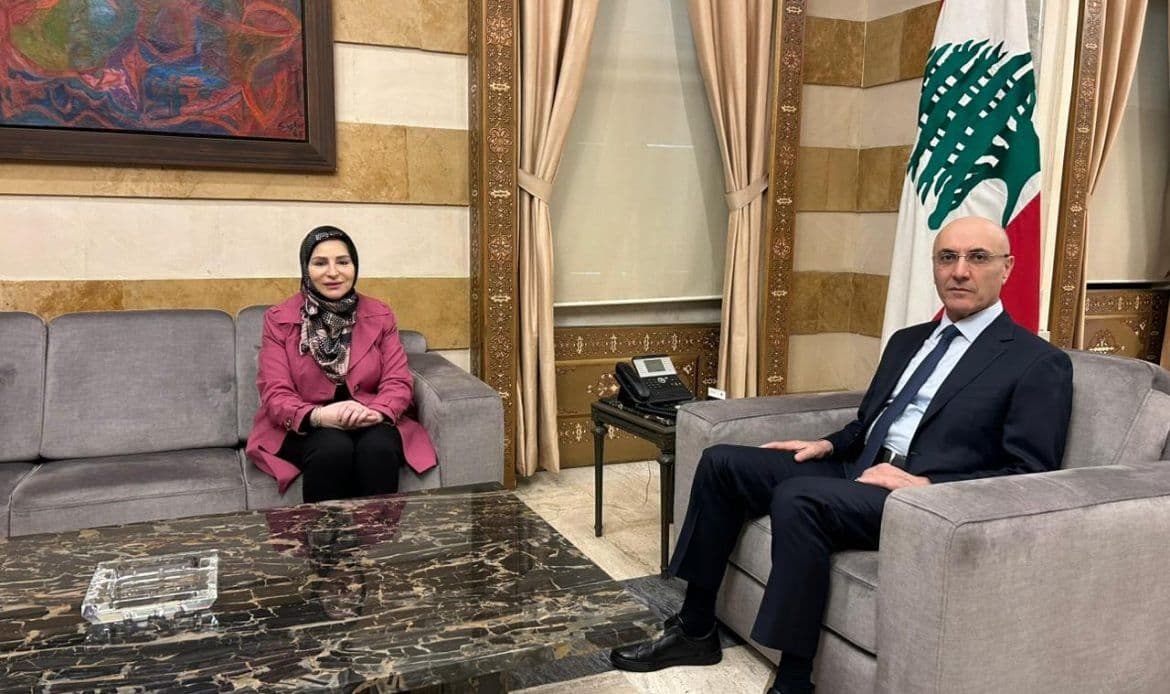
Faten Ali Younes
Director General of Political Affairs and Refugees; electoral administration and public-audit professionalA senior Lebanese public administrator from Machghara who moved from financial audit at the Court of Audit to first-category public office and has headed the Directorate General of Political Affairs and Refugees at the Ministry of Interior and Municipalities since 2014, with a central role in Lebanon’s electoral administration.
Biography
From Machghara to senior public administration
Faten Ali Younes is a senior Lebanese public administrator from Machghara in the West Bekaa. She built a long career in oversight and public administration before assuming one of the Ministry of Interior and Municipalities’ most important administrative positions connected to elections and political affairs.
Her career differs from a conventional partisan political path. It developed primarily through institutional public service, beginning at Lebanon’s Court of Audit, followed by promotion to the first category of the civil service and appointment as Director General of Political Affairs and Refugees. Since then, her name has been closely associated with the administration of major Lebanese elections as well as political-affairs and refugee-related files.
Birth and education: what is documented and what remains to be verified
Information International lists Faten Ali Younes as born in 1968 in its table of first-category public officials and records her appointment date as 2 April 2014. No open primary official source located for this profile provides a verified day and month of birth, so the profile does not assign a more precise date.
Published professional biographies state that she holds a diploma in public law, a diploma in business administration focused on management and marketing, and a degree in accounting and finance. They also mention professional courses in administration, finance, training, and procurement. The names of the universities and exact graduation dates have not yet been independently confirmed through a public university or government record, so these qualifications are presented as information found in published professional biographies rather than as a separately verified academic transcript.
The Court of Audit: a foundation in financial oversight
Before moving to the Ministry of Interior, Younes served at Lebanon’s Court of Audit and reached the rank of Senior Accounts Auditor. Parliamentary records repeatedly document her attendance in that capacity at Finance and Budget Committee meetings and subcommittees examining public accounts and final accounts.
On 18 October 2010, for example, Parliament recorded Senior Auditor Faten Younes among Court of Audit officials attending a Finance and Budget Committee session on public accounts. In 2011 she repeatedly attended the fact-finding subcommittee examining public accounting alongside judges, auditors, and Ministry of Finance officials.
She also attended the Finance and Budget Committee session of 20 February 2012 on the subsidized red-diesel case as a Senior Accounts Auditor at the Court of Audit. These records show that her pre-election-administration career was rooted in auditing, public accounts, and institutional financial oversight.
The subsidized red-diesel file and field auditing
During the 2012 subsidized red-diesel controversy, Younes’s name appeared in Court of Audit work related to checking quantities, distribution records, and information at petroleum facilities. Contemporary reporting described audit work by Court of Audit officials, including Younes, to examine data and deliveries connected to the subsidy and distribution process.
The episode is significant because it shows her experience extending beyond desk review of public accounts into a high-profile financial control file with direct implications for public funds and market distribution, shortly before her move into first-category public administration.
2 April 2014: promotion to the first category and appointment as Director General
The decisive turning point came in 2014. The Council of Ministers approved a draft decree promoting Faten Ali Younes, then a Senior Accounts Auditor in the Court of Audit, from the second to the first category, transferring her and appointing her Director General of Political Affairs and Refugees at the Ministry of Interior and Municipalities.
The appointment moved her from a financial oversight institution to senior executive administration. From that point, she became responsible for a directorate deeply involved in the organization and management of electoral procedures while also carrying responsibilities in political affairs and refugee-related administration.
What does the Directorate General of Political Affairs and Refugees do?
The Directorate General of Political Affairs and Refugees plays a central role within the Ministry of Interior and Municipalities, particularly in administrative procedures for parliamentary, municipal, and mukhtar elections. Its work includes handling candidacies and electoral lists, logistical and administrative preparation, coordination with ministry services and electoral bodies, and the processing and publication of results under applicable law.
The directorate also has responsibilities in political affairs and refugee-related files. The combination of electoral administration and sensitive administrative matters requires legal, procedural, managerial, and inter-institutional expertise.
Refugee affairs and undocumented persons
Younes’s work has not been limited to elections. As Director General, she participated in official meetings involving the Ministry of Interior, the Lebanese-Palestinian Dialogue Committee, and General Security on issues affecting Palestinian refugees.
One documented file concerned people lacking identification papers, procedures for issuing or renewing documents, and the creation of a dedicated register within the relevant administrations. Such meetings illustrate another dimension of her role involving legal identity, civil administration, and complex refugee-related cases.
The 2016 municipal and mukhtar elections
For the 2016 municipal and mukhtar elections, the Ministry of Interior formed a committee to administer the process that included Faten Younes and established a central operations room for the elections. The committee oversaw administrative and logistical readiness across the phased electoral schedule.
Public statements from that period illustrate the scale of the operation, which required tens of thousands of polling-station heads, clerks, judges, civil-status employees, and other staff. The 2016 elections were the first large nationwide electoral test after Younes assumed the directorate.
The 2018 parliamentary elections: a new law and the return of nationwide voting
The 2018 parliamentary elections were a defining point in her tenure. They were Lebanon’s first general parliamentary elections since 2009 and the first conducted under the new proportional-representation law with preferential voting, requiring new procedures for candidacies, lists, polling, and counting.
After nominations closed on 6 March 2018, Younes held a press conference on behalf of the Ministry and Directorate and announced a total of 976 candidates, including 111 women, compared with 702 candidates and only 12 women in the 2009 election.
At the list-registration stage, the final contest consisted of 77 lists and 583 candidates for 128 parliamentary seats after candidacies not organized into lists lapsed under the law. The Directorate had to administer substantial parts of the new procedures and communication with candidates, lists, and electoral centers.
Institutional Excellence Award in Arab Public Administration – 2018
In September 2018, the Dubai-based Awards Academy honored Younes with an Institutional Excellence Award in Arab Public Administration. The award organization linked the recognition to her management of the parliamentary elections, performance development, transparency, professionalism, and institutional commitment.
On receiving the award, Younes credited the wider Ministry of Interior team and particularly the Directorate General of Political Affairs and Refugees, reflecting the collective institutional nature of administering a national election.
ArabEMBs: an electoral-administration role beyond Lebanon
Younes also became active in regional electoral administration through the Arab Organization for Electoral Management Bodies, ArabEMBs. The organization’s 2015–2016 report states that its first General Assembly included representatives of six founding electoral bodies from Jordan, Iraq, Palestine, Lebanon, Libya, and Yemen, and identifies Faten Younes among the first General Assembly members representing Lebanon.
She continued participating in the organization’s activities and specialized conferences on electoral administration, including professional exchange on complaints, appeals, and electoral procedures. This places her experience within a regional professional network treating election management as a specialized institutional field.
Electoral training and cooperation with the United Nations
Under Younes, the Directorate worked with the United Nations Development Programme and international partners on training polling officials and improving electoral procedures. A notable example was the 2019 Tripoli parliamentary by-election.
UNDP documents eight training sessions for 730 polling officials held on 4 and 5 April 2019 through its electoral assistance project with European Union funding. Faten Younes attended and supervised the training, which covered receipt of ballot boxes, opening polling stations, voting, counting, tally sheets, temporary results, and packing electoral materials.
Women and political participation
In 2017, Faten Younes was appointed a member of the General Assembly of Lebanon’s National Commission for Lebanese Women. Combining this role with her position in electoral administration placed her at the intersection of election management and women’s political participation.
A gender-focused monitoring report on the 2022 elections documented an interview with Younes as Director General and a member of the National Commission. The report noted steps by the Directorate such as making nomination receipts more gender-sensitive and adding a gender field, allowing electoral data to be disaggregated by sex.
The 2022 parliamentary elections
Younes continued to oversee procedures and preparations for the 2022 parliamentary elections. At the close of list registration, she announced that 100 lists had been registered, up from 77 in 2018.
The elections took place amid severe economic, administrative, and logistical pressures. Preparations required coordination among the Ministry of Interior, civil-status services, security agencies, and polling staff, as well as arrangements relating to Lebanese voters abroad. The Directorate General of Political Affairs and Refugees remained at the center of candidacy, list-registration, and electoral-administration procedures.
The 2025 municipal and mukhtar elections
The Directorate remained central to the 2025 municipal and mukhtar elections. On 19 May 2025, Younes received the results for Zahle, West Bekaa, and Rashaya from the Bekaa governor and acting district commissioners as transmitted by the Higher Registration Committees, for entry into the Ministry’s system and official publication.
For a senior administrator from Machghara, this moment carries particular local resonance: she stood at the central administrative point receiving results from the West Bekaa district that includes her hometown, alongside her responsibilities for electoral results from other regions.
Participation in legislative debate on election laws and the Senate
Beyond the administrative implementation of elections, Younes has participated as the relevant senior public administrator in parliamentary sessions examining electoral legislation itself. Lebanese Parliament records document her attendance at different stages of debate over amendments to the parliamentary election law and its implementation.
On 2 June 2025, she attended the subcommittee of the joint parliamentary committees studying proposals concerning parliamentary elections and the Senate. She later participated in sessions addressing election-law amendments and the legal preparations for the 2026 election, including meetings of the Foreign Affairs and Emigrants Committee and the National Defense, Interior and Municipalities Committee.
This record shows that the Directorate’s role extends beyond applying legislation after enactment to providing administrative and technical expertise during legislative and governmental discussion of amendments and implementation mechanisms.
Preparing the 2026 parliamentary elections
Official sources confirm that Younes remained Director General of Political Affairs and Refugees during preparations for the 2026 parliamentary elections. On 10 February 2026 she accompanied Interior Minister Ahmad al-Hajjar during an inspection of the office receiving candidacy declarations as the nomination period opened and administrative and logistical preparations continued.
She also participated in the Minister’s meeting with the European Union exploratory mission for election observation, where the Ministry presented comprehensive administrative and logistical preparations and discussed cooperation and coordination with the European mission. These records confirm the continuation of her electoral responsibilities more than a decade after her appointment.
More than a decade at the center of electoral administration
Since her appointment in 2014, Faten Younes has remained in office through a sequence of different electoral events: the 2016 municipal and mukhtar elections, the 2018 parliamentary elections, the 2019 Tripoli by-election, the 2022 parliamentary elections, the 2025 municipal and mukhtar elections, and preparations for the 2026 parliamentary elections.
This continuity has given her accumulated experience in electoral law and procedure, training, logistics, candidacy and list registration, results management, and coordination across public institutions, building on her earlier experience in financial oversight. Her career therefore bridges two important fields of public administration: public financial accountability and electoral management.
Her place among Machghara’s prominent figures
For Machghara, Faten Ali Younes represents a contemporary example of a member of the town reaching senior Lebanese public administration through a long professional career in oversight and management.
The significance of her profile lies not in partisan politics but in institutional public service and the administration of national processes affecting Lebanese citizens across political and sectarian lines. In this sense, she joins Machghara’s record of figures in law, justice, administration, and academia as one of its notable contemporary public administrators.
Documentation note
The core facts in this profile are based primarily on government, parliamentary, international, and electoral-monitoring sources, especially the Council of Ministers, Lebanese Parliament, Ministry of Interior and Municipalities, UNDP, ArabEMBs, and election-monitoring reports.
The birth year 1968 comes from Information International’s published table of first-category officials. Detailed academic qualifications are drawn from published professional biographies; because a public primary university record identifying institutions and graduation dates has not yet been located, the profile does not present unverified academic details beyond what those biographies state.
Notable Contributions
Advanced from Senior Accounts Auditor at Lebanon’s Court of Audit to first-category public office, with documented experience in public accounts and financial oversight.
Has served as Director General of Political Affairs and Refugees at the Ministry of Interior and Municipalities since 2014.
Helped administer Lebanese municipal, parliamentary, and by-elections between 2016 and 2026 and supported electoral procedures and training.
Represented Lebanon’s electoral administration within ArabEMBs and was identified among the organization’s first General Assembly members.
Contributed to gender-sensitive electoral administration and sex-disaggregated electoral data through her election-management role and membership in the National Commission for Lebanese Women.
Participated in administrative work concerning Palestinian refugees and people lacking identity documents.
Received the 2018 Institutional Excellence Award in Arab Public Administration in recognition of election management and institutional performance.